AI for hospital operations & quality

Automate hospital operations.
Stay continuously NABH & JCI ready.

Four applications writing to one operational record. Rounds, checklists, complaints and incidents reach staff on WhatsApp and are logged by voice, so your staff do less and the NABH/JCI documentation stays ready on its own.

  • Voice AI logging: speak, don't type
  • Continuously NABH/JCI audit-ready
  • Live readiness view, nothing to assemble

EaseOps automates daily hospital operations, with rounds, audits, incident logging, patient complaints and SOP control logged by voice and delivered on WhatsApp. Hospitals stay continuously NABH and JCI ready without manual paperwork, across 60+ locations in India.

Do the round. The file builds itself.

Ready on any day, not just assessment day.

Rounds, incidents, drills and maintenance write their own dated, attributed records as they happen. When the assessor asks, the file is already there.

Running across 60+ locations in India, as of September 2026.

What is EaseOps?

EaseOps is an AI-native hospital operations and quality platform. Four applications (Operations, EaseQMS, EaseAsset and AccredAI) run the daily work on WhatsApp and write to one operational record: rounds, checklists, incidents, equipment and SOPs. Voice logging, AI gap analysis against NABH and JCI, semantic SOP search and a live readiness view are built in. Hospitals do less manual work and stay continuously NABH/JCI-ready.

Four applications, one operational record

Each answers a question a hospital is already asking. They share the same staff, the same phones and the same audit trail, so you can start with one and add the others without a second rollout.

EaseOps Operations

Did the work actually get done?

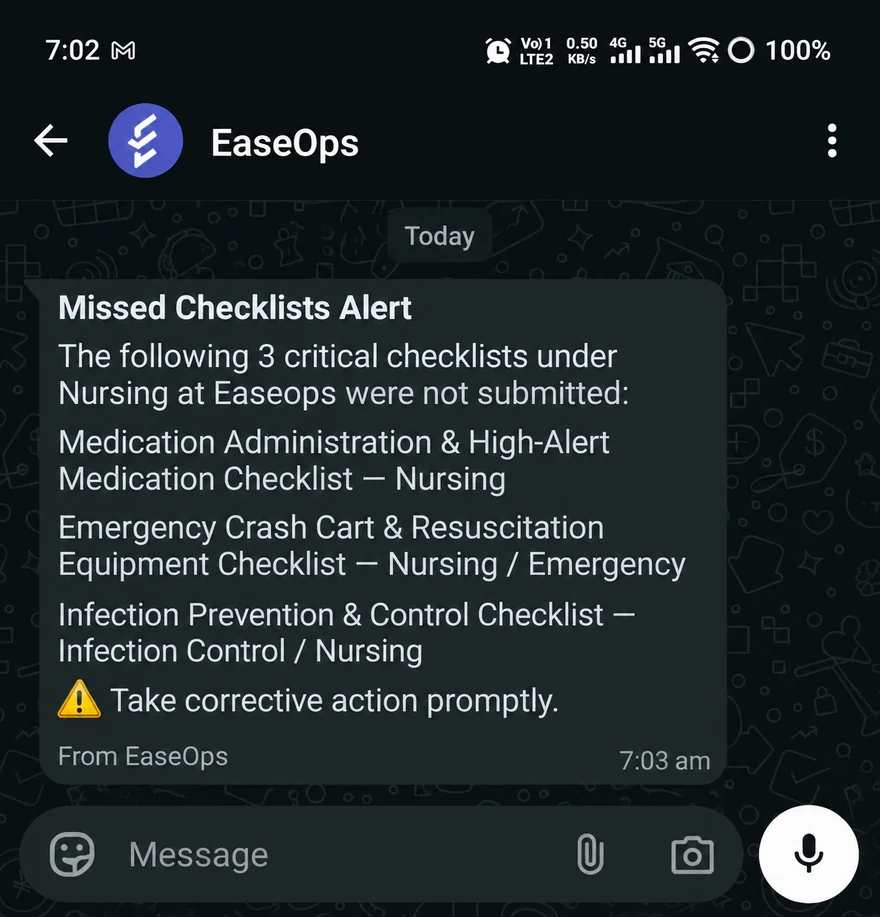
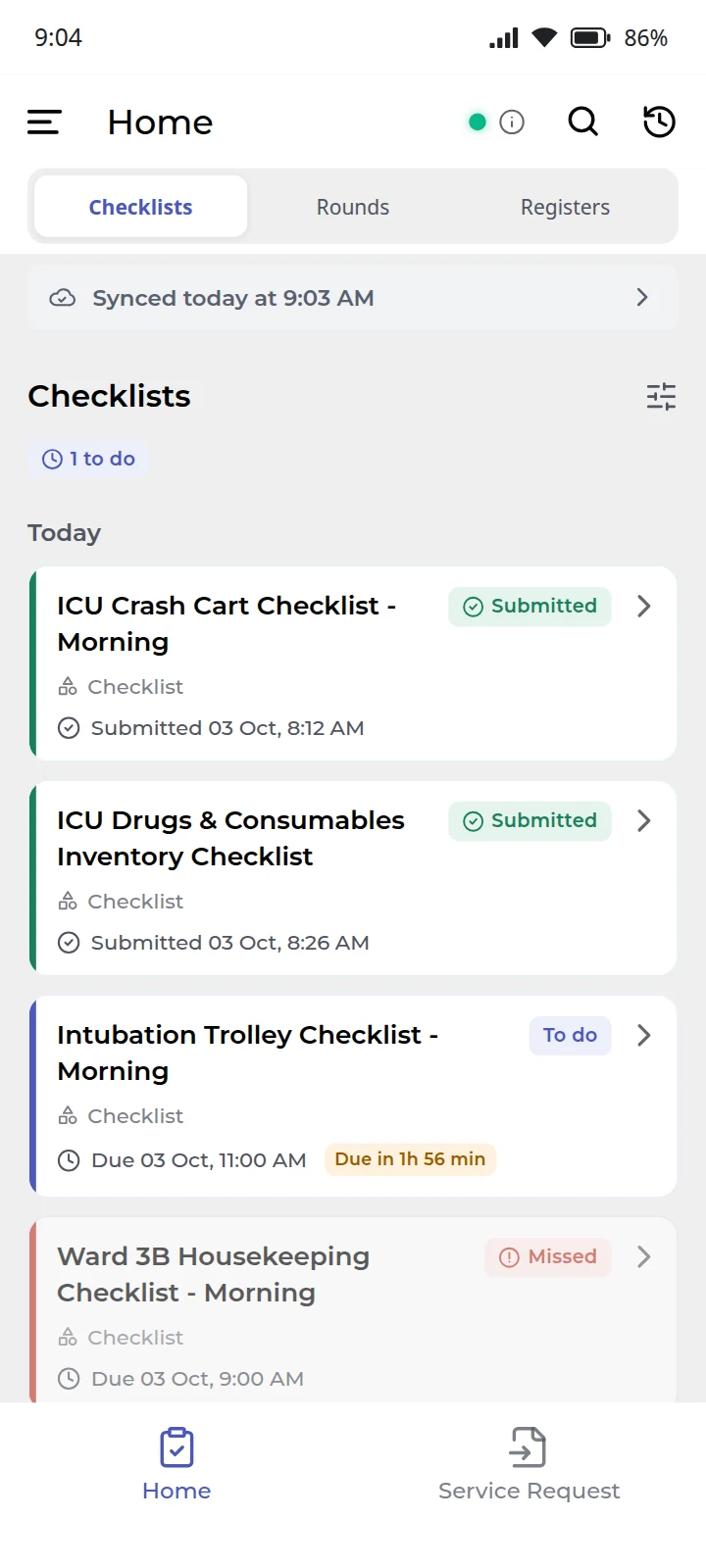
Checklists, rounds and registers go out to staff phones on a schedule and come back with a photo, a signature and a timestamp, scored rather than ticked. When something critical is missed, EaseOps says so on WhatsApp while there is still a shift left to fix it.

  • Checklists & rounds
  • Patient concierge
  • Department concierge
  • Patient surveys
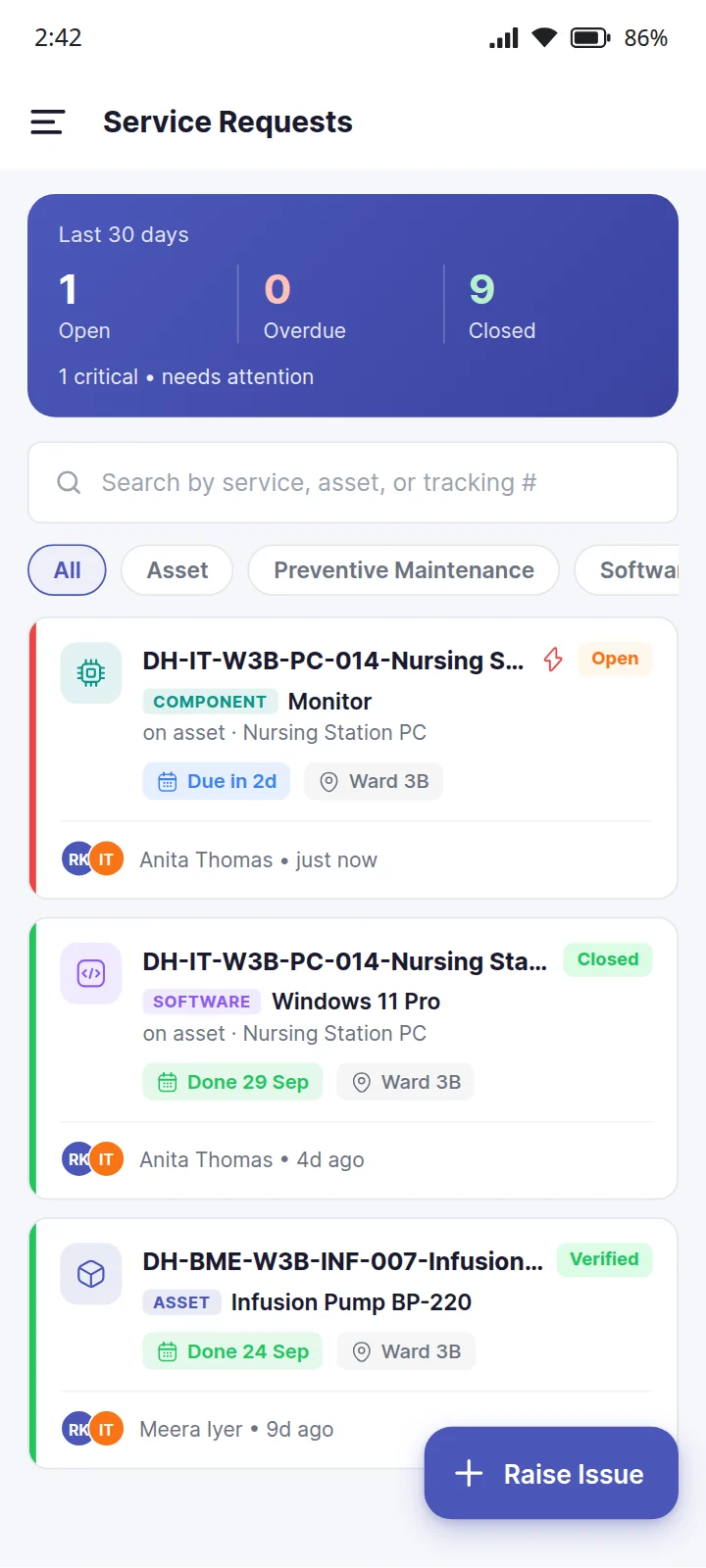
  • Service requests
  • Forms & registers
Explore EaseOps Operations
A WhatsApp alert from EaseOps listing three critical nursing checklists that were not submitted, each named with its department.
A missed-checklist alert, on the app staff already have open. Three critical checklists, each named with the department answerable for it.

EaseQMS

Something went wrong. What did we do about it?

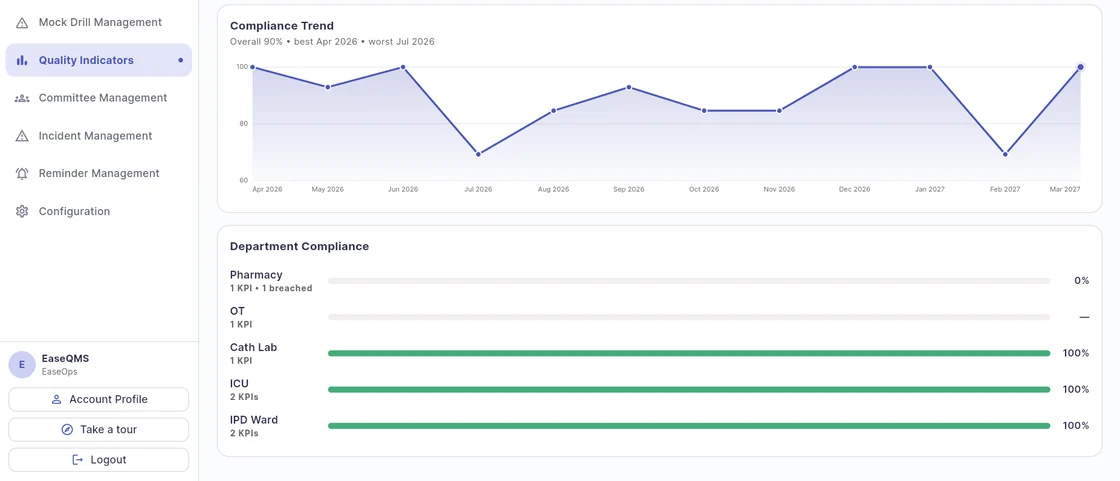
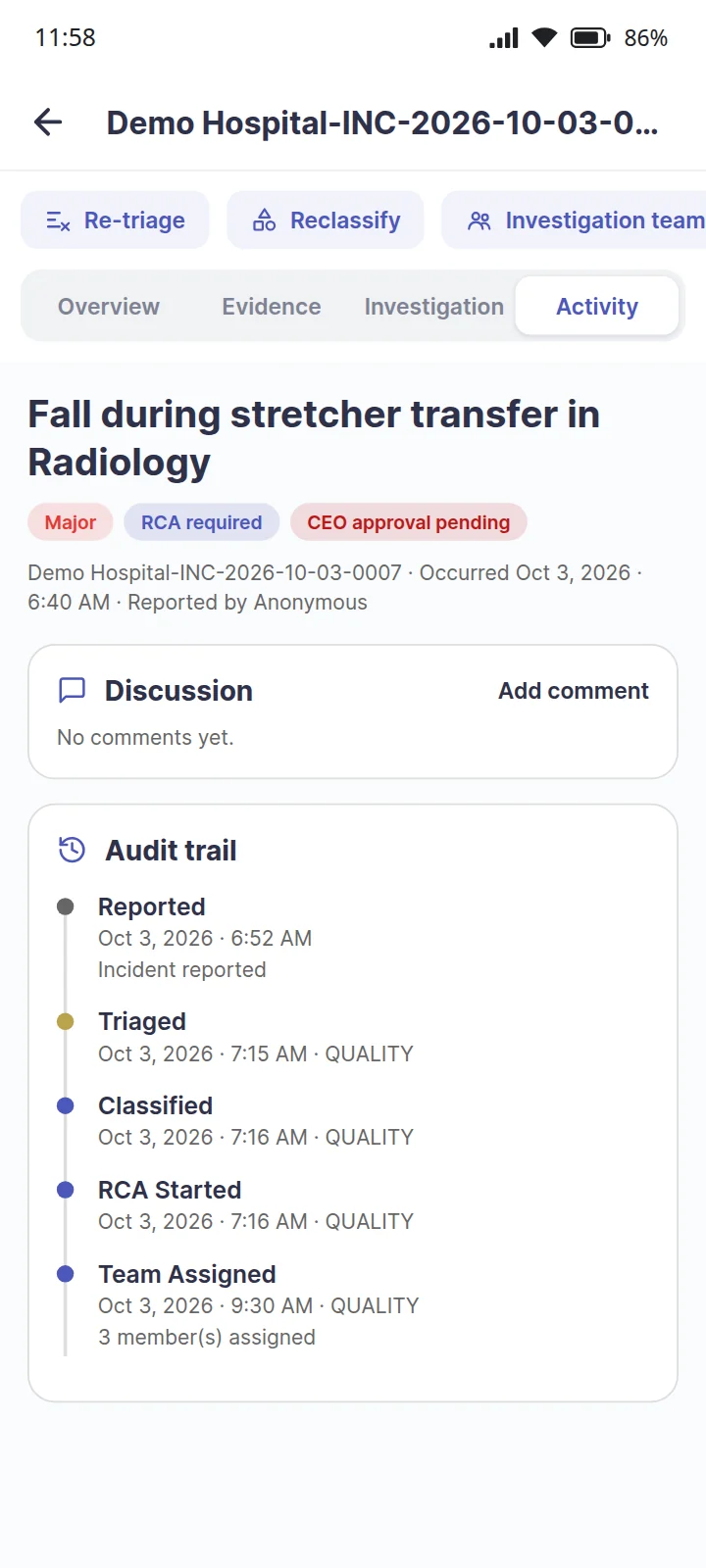
Incidents and grievances arrive by QR or by form, take a severity, and follow the workflow that severity forces, approvals included. Quality indicators compute themselves from the registers underneath, and a breach opens a CAPA rather than waiting for someone to notice it in a spreadsheet.

  • Incidents & grievances
  • Mock drills
  • Quality indicators
  • Committee management
  • Reminders
  • Document control
Explore EaseQMS
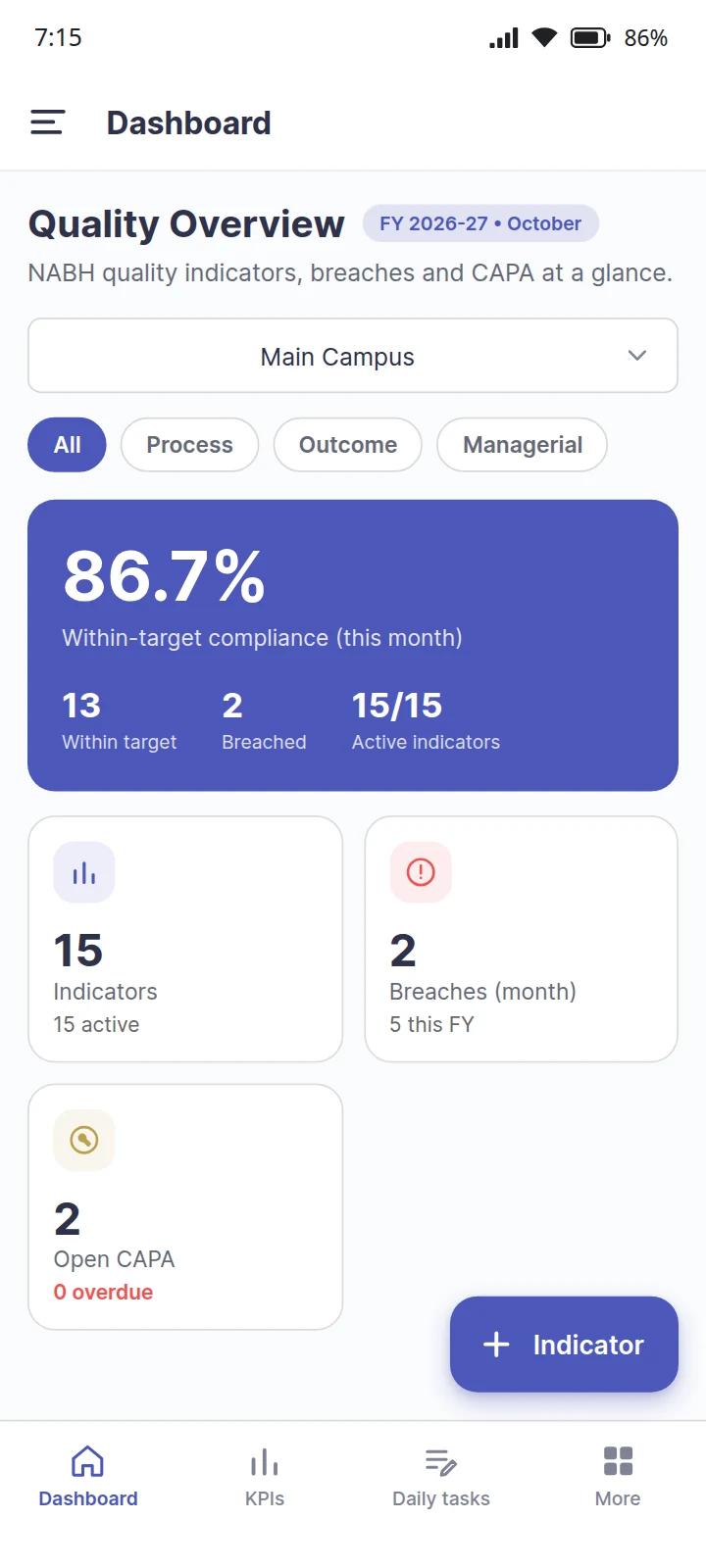
The EaseQMS quality indicators dashboard: a twelve-month compliance trend line and per-department compliance bars, with one breached pharmacy indicator at zero per cent.
Twelve months of compliance, department by department, with the one breached indicator shown as a breach rather than buried in an average.

EaseAsset

Where is that ventilator, and when was it last serviced?

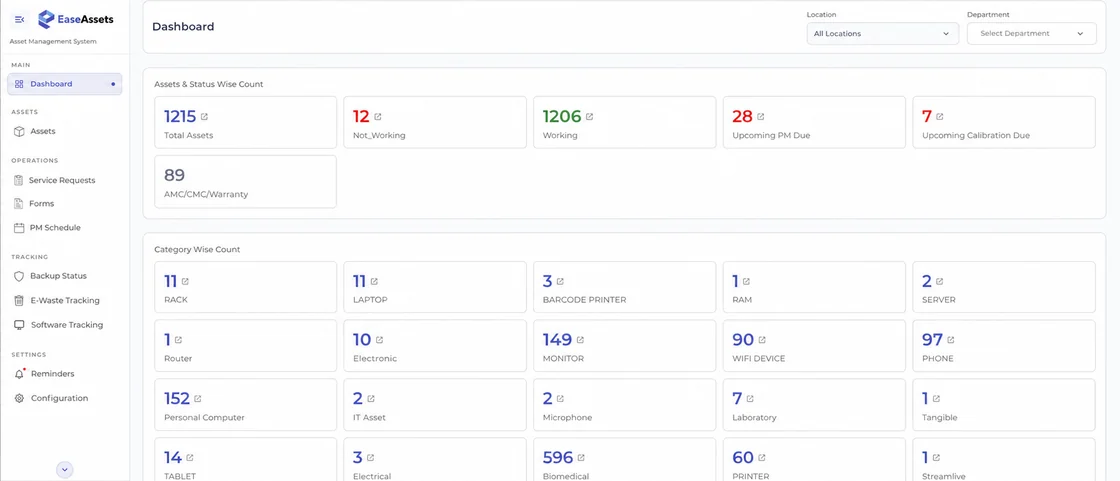
Every asset carries a QR code. Scan it to raise a breakdown, read its service history, or sign it out on a gate pass. Preventive maintenance and calibration schedule themselves and chase the engineer, so the FMS evidence an assessor asks for is a by-product of the equipment being looked after.

  • Asset register
  • Service requests
  • Preventive maintenance
  • Calibration
  • AMC/CMC contracts
  • E-waste tracking
  • Software & backup
Explore EaseAsset
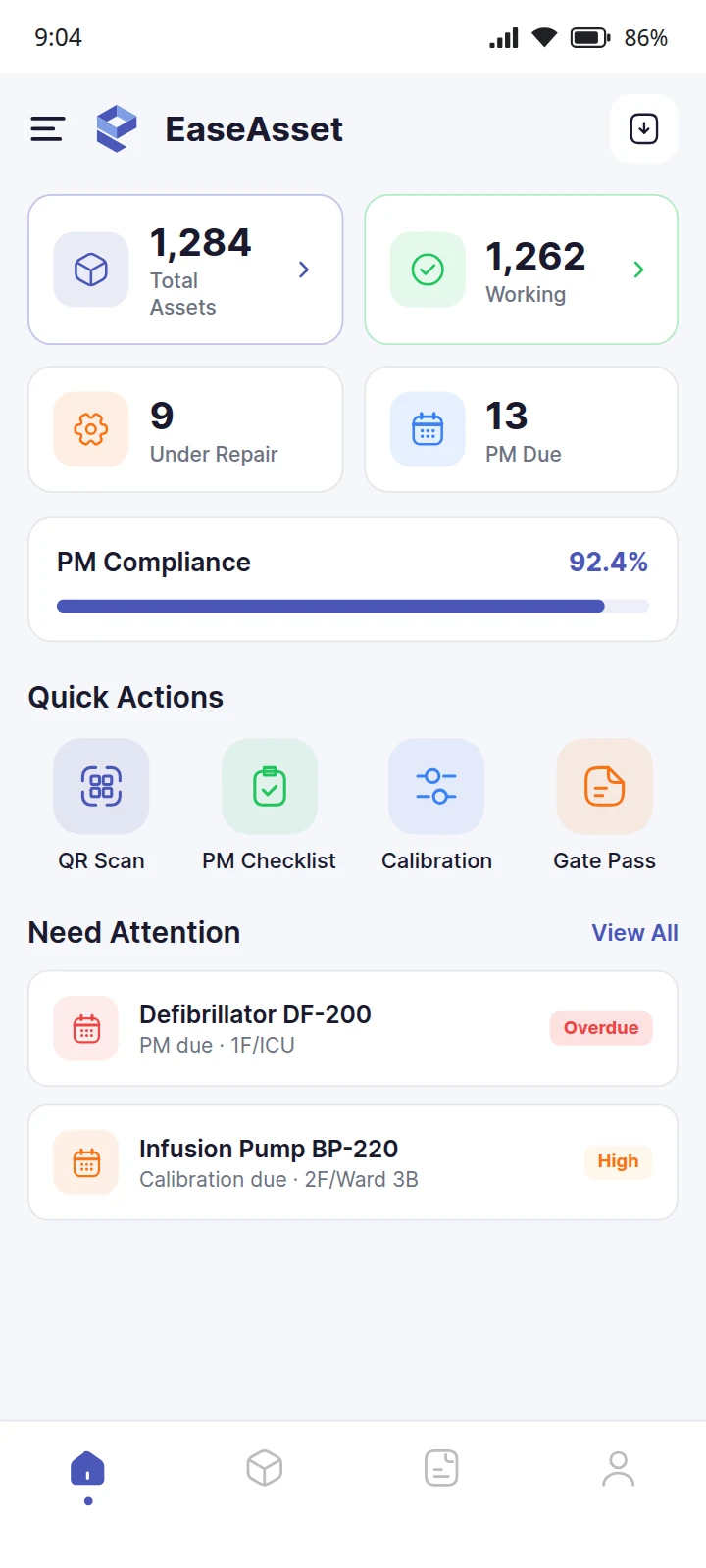
The EaseAsset dashboard showing 1,215 total assets, 1,206 working, 12 not working, 28 preventive-maintenance jobs due and 7 calibrations expiring.
1,215 assets, 12 down, 28 maintenance jobs due and 7 calibrations expiring, answered on one screen instead of out of a register.

AccredAI

Are we actually ready for the assessment?

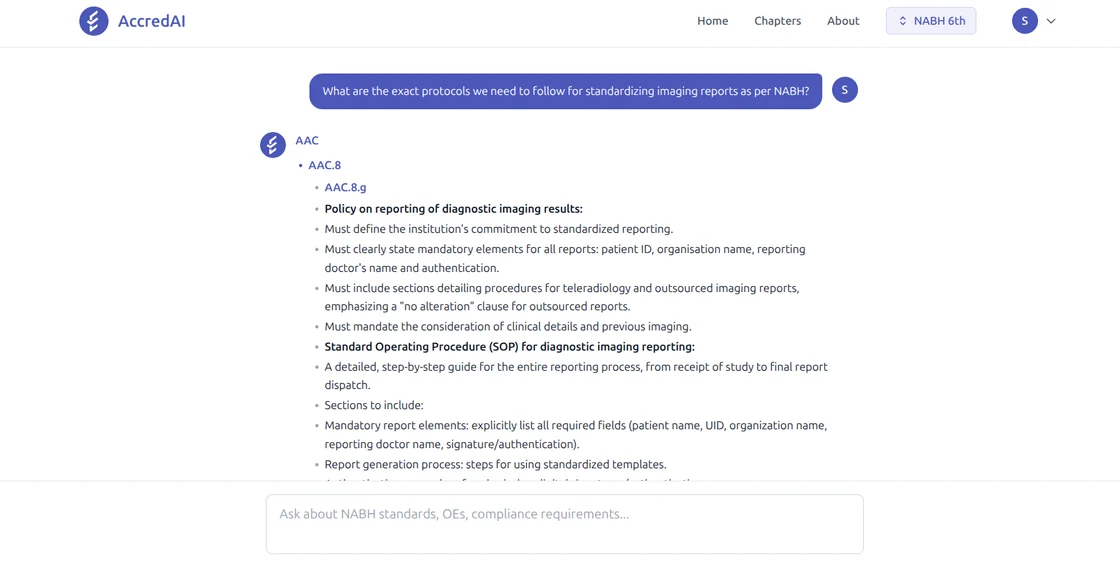
Ask anything about NABH or JCI in plain English and get an answer against the standard as it is currently written, with the chapter and objective element cited so you can check it yourself. It reads the evidence the other three are already producing, which is what turns a general answer into a gap in your hospital.

  • NABH 6th Edition
  • JCI standards
  • Chapter & OE browser
  • Cited answers
Explore AccredAI
AccredAI answering a question about standardising imaging reports, citing NABH chapter AAC standard 8 objective element g, and listing the policy and SOP elements required.
A question about imaging-report protocol, answered and cited to AAC.8.g: a reference you can take to an assessor, not a search result.

Each of those writes its own record as it happens. That is the whole idea: the evidence is a by-product of doing the work, so it is already there when an assessor asks for it.

Four applications are not four systems

The usual alternative is a quality system that sits beside the hospital’s actual operations. Staff do the work, then someone re-enters a version of it so there is something to show. The re-entry is the expensive part, and it is also where the record stops matching reality, which is exactly what an experienced assessor probes for.

One action

10:00Ward round, Ward 3. Twelve checks.

Logged 10:02

Round done. Bed 4, IV line check failed. Bed 9, fall-risk band missing. Raised both.

Scored 10 of 12. Two service requests opened, with an owner and a due time on each.

Sample data, to show the flow.

  • As operations

    EaseOps Operations

    The round is closed, scored, and attributed. Two failed checks became a service request with an owner and a due time.

  • As quality data

    EaseQMS

    The same submission feeds the indicator it belongs to. Nobody transcribes it into a quality register, because it is already in one.

  • As evidence

    AccredAI

    It is a dated, attributed record against the NABH standard it satisfies, available the day an assessor asks rather than assembled the week before.

Because the four write to one record, the re-entry step does not exist. A completed round is operational data, quality-indicator data and accreditation evidence at once, without being recorded three times.

What crosses between them, and when

Separate tools create gaps that make no noise. A complaint logged in one system never reaches the quality team in another. An equipment fault stays in the maintenance log and never becomes a corrective action. Preparing for an assessment means pulling four reports and hoping they agree. These hand-offs happen on their own.

  • EaseOps Operations feeds EaseQMS

    • A complaint raised at the bedside becomes a formal incident, carrying the severity it was triaged at and the approval chain that severity forces.
    • A failed round task opens a service request against the department answerable for it, with an owner and a due time already attached.
    • Concierge resolutions feed the patient-experience indicators instead of closing in a log nobody reads back.
  • EaseAsset feeds EaseQMS

    • A breakdown raised by scanning the QR on the device opens a corrective action, rather than closing as a repair note.
    • Preventive maintenance that was scheduled and not done shows up in the PM indicator, which is the number an assessor actually asks about.
    • Calibration and facility records feed accreditation readiness as they are signed off.
  • All three feeds AccredAI

    • One readiness view drawn from every module, rather than four reports pulled and reconciled.
    • Every record dated and attributed at the moment it was created, not reconstructed afterwards.
    • A gap is a gap in your hospital, because the evidence being read against the standard is your own.

The platform

AI built into almost every module, not a badge

This is what AI-native means in practice. Not a chatbot bolted on top of the workflows that already existed, but AI sitting inside the specific tasks where it removes the most work, each one replacing a step somebody used to do by hand.

  • Voice AI

    Speak instead of typing, in every module. Staff dictate notes, observations and incident reports; EaseOps transcribes them and files them against the right record.

    Replaceswriting up a whole shift into a register after it has ended

  • AccredAI

    Ask anything about NABH 6th Edition or JCI in plain English and get the answer against the standard as it is currently written, with the chapter and objective element cited.

    Replacesa consultant reading every file to tell you what is missing

  • Lumen AI search

    Semantic search across every SOP and policy. Staff ask the question they actually have and get the passage that answers it, not a list of filenames to open one at a time.

    Replaceshunting a shared drive for the version that is current

  • Smart suggestions

    AI-drafted resolution steps for patient complaints and incident CAPA. Staff review and confirm; the suggestion is what usually works for this kind of issue.

    Replacesa blank CAPA form and a guess at the root cause

  • Threshold alerts

    Quality indicators are watched as they are captured. A breach notifies the people answerable for it, scoped to their department, the moment the number crosses the limit.

    Replacesnoticing at month end, or not noticing

  • NABH readiness dashboard

    One live score aggregated from Operations, EaseQMS and EaseAsset, moving as staff close rounds, file incidents and sign off corrective actions.

    Replacesassembling four reports the week before an assessment

WhatsApp-native: there is no new app to learn

Everything staff do day to day happens on the app that is already open on their phone. Management gets a real screen to run the hospital from. Patients get a QR code and no account at all.

  • Ward and support staff

    WhatsApp and the field app

    Tasks arrive on the phone already in their hand. Rounds, checklists, registers and forms come back with a photo, a signature and a timestamp, and a note can be spoken rather than typed.

    Works with no signal, and syncs when it returns.

  • Quality team and management

    The web admin panel

    Where all of it is set up and all of it is watched: schedules, scoring rules, escalation ladders, users and departments, against live dashboards, overdue service requests and exportable reports.

    Full width on a laptop, the same screens on a ward tablet.

  • Patients and visitors

    A QR code at the bed

    Scan it and raise a request in seconds. It routes to the department that can act on it, with an owner and a due time attached, and notifies them where they will see it.

    No app to install, no account, no switchboard.

  • Patients at discharge

    A survey QR code

    Ratings captured per department, so satisfaction is measured where it was produced. A low score opens a corrective action with a suggested remedy rather than closing as a number.

    Feeds the patient-experience indicators directly.

This is not a convenience feature. Adoption is the hardest problem in hospital software and it is usually lost at the login screen, so none of these four asks anyone to work somewhere new.

The Difference

Others digitize your documents.
EaseOps puts AI to work on your operations.

Documentation-first tools

  • Digitize the paperwork
  • Staff still do it all, then type reports
  • Audit = last-minute scramble
  • Runs on people chasing and memory
  • One more system to log into

EaseOps (AI-native)

  • AI runs the actual daily work
  • Staff do less: voice + WhatsApp, AI files it
  • Continuously audit-ready
  • AI + notifications and escalations do the chasing
  • Runs where staff already are
Results

What changes in the hospital

Staff do less. Documentation writes itself. The hospital stays ready.

Requests reach the right person

A QR scan at the bedside opens a service request routed straight to the department that can act on it, with an owner and a due time already attached. No switchboard, no chasing.

Equipment ready when it is needed

Preventive maintenance and calibration run on a schedule the system keeps and the system chases, so a device is serviced before it fails rather than after.

Patient concerns become actions

A complaint raised at the bedside opens a tracked request with an escalation ladder behind it, instead of a line in a register nobody reads back.

The same standard every shift

Checklists go out on a schedule and come back scored, with a photo and a timestamp, so the quality of a round does not depend on who happened to be on duty.

Problems surface before they spread

Missed checks, breached indicators and overdue requests escalate on their own, while there is still a shift left to do something about them.

Less paperwork, more patients

Staff log work by voice on WhatsApp instead of filling registers at the end of a shift. The documentation is a by-product of the work, not a second job after it.

OfficialNABH Digital Mitra

What a NABH Digital Mitra actually is

NABH awards the credential to platforms that run hospital workflows, not to tools that file the paperwork afterwards. When your hospital runs on one, assessors can verify the digital implementation without auditing it themselves.

Most hospital software

Gives staff a digital form instead of a paper one. The timestamp records when someone filled the form in, not when the work happened, which is the same evidence quality as paper.

An official Digital Mitra

Runs the operation itself, so the evidence accumulates as staff work and the package is complete at any point in time, not assembled in the weeks before an assessment.

  • Rounds, incidents and drills run in the system, so each one writes its own timestamped record.
  • The platform is verified against NABH’s digital requirements, so your hospital does not have to demonstrate it separately.
  • AccredAI re-checks gaps as standards change, rather than waiting for a consultant to notice.

How the credential works, and why most tools do not qualify

Proof

Hospitals already running on EaseOps

Across 60+ locations in India, from single-site nursing homes to multi-speciality groups.

"EaseOps has revolutionized our operations. The 90% reduction in paperwork has allowed our staff to focus more on patient care. The real-time compliance monitoring is exactly what we needed."

NK
Mr. Nand Kumar
Quality Head
Greenview Medical Center

"The patient concierge system through QR codes has significantly improved our patient satisfaction scores. Service requests are now handled within minutes instead of hours."

MR
Dr. Mohan Reddy
Director
Nano Hospitals

"Implementation was seamless and the training was comprehensive. Our audit processes that used to take days now complete in hours with better accuracy and compliance."

DB
Dr. Divi Bhatia
Hospital Administrator
RxDx Clinics
Security

On security and compliance, plainly

We build to India's DPDP Act 2023, the framework that governs hospital data here. Here is what that means in practice.

Running a security review? Write to enquiry@easeops.io and we will send our current documentation.

Encrypted in transit

Every connection between a staff phone, a browser and our servers runs over TLS.

Backed up daily

Backups run automatically every day, without anyone having to remember to take them.

Your data stays yours

Export it whenever you ask. It is never sold.

Built to DPDP Act 2023

India's hospital data framework is the standard we design and build against.

Get Started

Tailored to Your Hospital

Every hospital is different. Tell us about your facility and we'll put together a plan that fits your size, departments, and goals.

What's Included in Onboarding?

Our comprehensive setup process ensures you're up and running quickly with minimal disruption.

Step 01

Checklist Digitization

Converting manual checklists into digital workflows

Step 02

Audit Digitization

Transforming paper audits into structured formats

Step 03

Asset Onboarding

Cataloging all hospital assets into the system

Step 04

Account & Access Setup

Creating user accounts and configuring access

Step 05

On-Ground Staff Training

Practical training for all operational staff

Step 06

Department Head Briefing

Leadership orientation and usage training

Step 07

QR Code Feedback Setup

Designing and deploying feedback QR codes

Step 08

Patient Concierge QR Setup

Creating service request QR codes for departments

Common questions

  • What is EaseOps?

    EaseOps is an AI-native hospital operations and quality platform. It automates daily work on WhatsApp and voice: rounds, checklists, patient complaints, incidents, quality indicators and SOP management, with AI built into almost every module. All four applications share one operational record, so a patient complaint becomes an incident, an equipment fault opens a corrective action, and NABH readiness reflects both as they happen. Hospitals do less manual work and stay continuously NABH/JCI-ready.

  • What are the four EaseOps applications?

    EaseOps Operations runs rounds, checklists, registers, patient concierge and surveys. EaseQMS runs incidents, CAPA, mock drills, quality indicators, committees and document control. EaseAsset runs the QR equipment register, preventive maintenance, calibration and e-waste. AccredAI answers NABH and JCI questions with the standard cited. All four write to one operational record, so a hospital can start with one and add the others without a second rollout.

  • Is EaseOps one product or several?

    One platform with four product modules that share data. You can start with the module that solves your most urgent problem and expand from there. The value compounds when the modules are connected, because the data then flows between them automatically instead of being carried across by hand.

  • What does AI in every module actually mean?

    Voice transcription in every module, smart suggestions for complaint and CAPA resolution, semantic SOP search through Lumen, AI gap analysis against NABH and JCI in AccredAI, and threshold alerts on quality indicators. Each one is a specific function that removes a specific manual step, not a general-purpose chatbot bolted onto the side.

  • Do staff need to download a new app?

    No. Day-to-day work runs on WhatsApp, which hospital staff already use: tasks arrive, rounds are logged by voice, incidents are raised and patient requests are handled without leaving it. Patients and visitors need nothing at all: a QR code at the bed opens a request with no app and no account. Management dashboards and reports are on the web and mobile apps, where administrators see live data and act on it.

  • How does EaseOps help with NABH accreditation?

    EaseOps runs the daily operations NABH assesses (rounds, checklists, incidents, CAPA, quality indicators and SOP control) and records them automatically. AccredAI adds AI gap analysis against NABH 6th Edition standards. The audit trail builds itself as staff work, so hospitals are continuously ready rather than scrambling before an assessment.

  • How is EaseOps different from running a separate QMS tool and an operations tool?

    When they are separate, the data does not cross. A patient complaint in operations never becomes an incident in the QMS unless somebody copies it over, and an equipment fault stays in the maintenance log. EaseOps connects them: the data flows, the evidence builds as the work is done, and management reads one picture instead of reconciling two reports.

  • What is NABH Digital Mitra?

    NABH Digital Mitra is an official credential awarded to platforms that genuinely implement NABH's digital accreditation requirements. EaseOps is a certified NABH Digital Mitra, meaning its workflows are pre-verified against NABH standards, not just digitized paperwork.

  • Once we sign, are we on our own?

    No. Onboarding happens with you, on site: your checklists and audits are digitised, your assets are catalogued, accounts and access are set up, ward staff are trained on the ground and department heads are briefed, in the eight steps listed on this page. After go-live you keep a dedicated account manager and ongoing support, so a question does not wait for a renewal to be answered.

  • What happens on a ward with no signal, or when the power goes?

    Rounds, checklists, registers and asset work run in an offline-first field app on the phone already in the staff member's hand. Raising a request or logging a round never needs the network; everything syncs when it returns. Management dashboards and the quality system are used online, from the web and mobile apps.

  • Where does our hospital's data live, and who can see it?

    It stays yours. Every connection between a phone, a browser and our servers runs over TLS, backups run automatically every day, you can export your data whenever you ask, and it is never sold. We build to India's DPDP Act 2023, the framework that governs hospital data here, and we send our current security documentation to any hospital running a review.

Ready to put AI to work on your hospital's operations?

Join 60+ locations across India that stay continuously NABH/JCI-ready with EaseOps.